Contact With us
2028, New York
contact@fufo.com
+1300 877 503
Call For Inquiry
+00 (002) 896 22
More Services
General Information
About Sudan
The name "Bilad al-Sudan" was originally given to the region located south of the African Sahara, stretching from the Atlantic Ocean in the west to the Red Sea and the Indian Ocean in the east. Today, this name specifically refers to the territory located south of Egypt, representing the central part of the Nile Basin. In the Torah and Assyrian texts, this land was referred to as "Kush." As for the current name (Sudan), it is the plural form of the word "Black" in Greek.
The Republic of Sudan is an Arab-African state representing a unique social fabric with diverse cultures, ethnicities, and features that are rarely found anywhere else in the world.
Location and Area
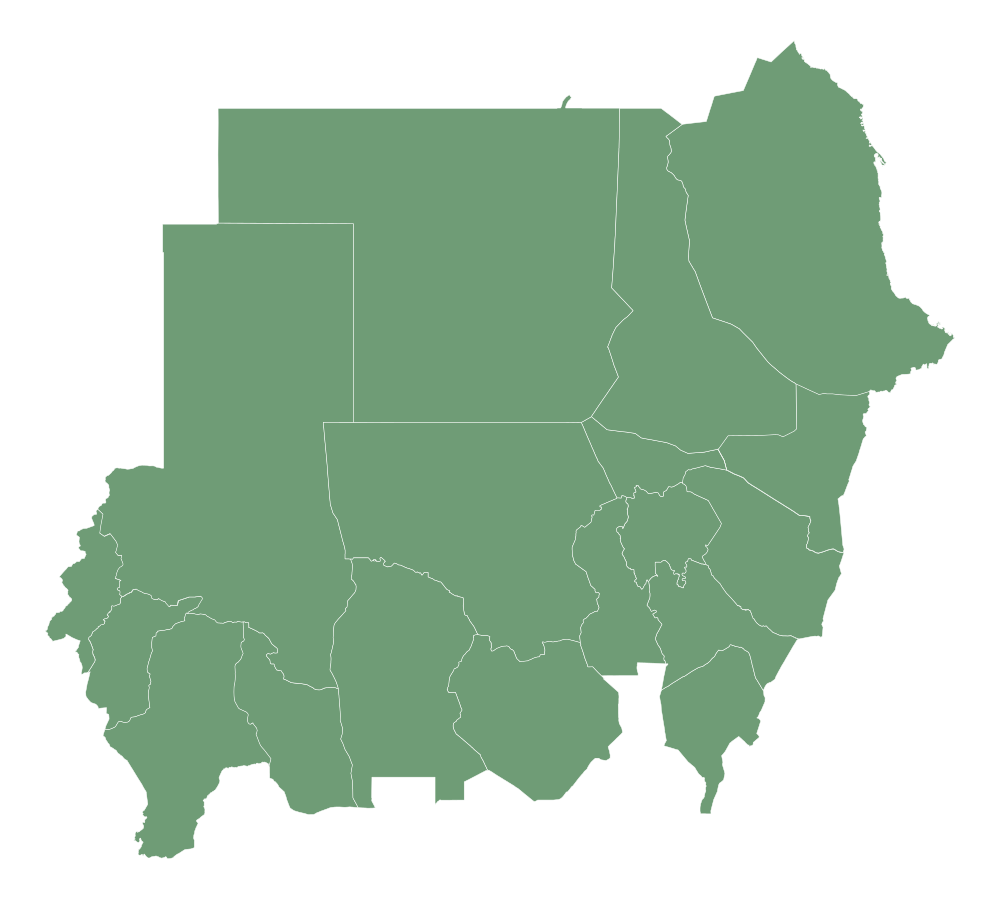
Sudan is located in the northeastern part of Africa between latitudes 22.4 North and longitude 38.22. It occupies a central position between Africa and the Arab world. This location has granted Sudan a unique advantage as the main gateway between North and South Africa. Until the middle of the last century, it remained the primary route for pilgrimage and trade caravans from West Africa to the Holy Lands and East Africa.
The area of Sudan is approximately 1,882,000 square kilometers, making it one of the largest African countries. It ranks 16th globally in terms of area. It is the second-largest African country after Algeria and the third-largest Arab country after Saudi Arabia and Algeria. The land area constitutes 1,752,187 km2, while the water area is 129,813 km2.
Neighboring Countries
Sudan is bordered by seven countries: Egypt, Libya, Chad, the Central African Republic, Ethiopia, Eritrea, and the Republic of South Sudan, in addition to the Red Sea.
Climate
Sudan is dominated by a tropical climate characterized by high temperatures throughout most of the year. It ranges from very arid in the far north to semi-humid in the south.
- North (Northern State, North Kordofan, North Darfur): Desert and semi-desert climate.
- Central and South: Rainy climate.
- Topography: Mostly flat plains with highlands in the east and the Nuba Mountains and Jebel Marra in the west.
- Coordinates: It lies between latitudes 8.45 and 23.8 North, and longitudes 21.49 to 38.24 East.
Annual rainfall rates range from near zero in the far north to between 500 mm and 1000 mm in other parts of Sudan.
The Nile and its various tributaries play a vital role in Sudan's economic, social, and cultural life, as well as its foreign relations. The waters of the Nile are used to generate electricity from the Roseires, Sennar, Khashm el-Girba, Jebel Aulia, and Merowe dams, as well as for navigation and fishing. Groundwater reserves are estimated at approximately 900 billion cubic meters for irrigation and civil use.
Population
The population of Sudan was estimated at the beginning of 2011 to be approximately 33,419,625. The people of Sudan consist of tribes descending from Arab, African, and Nubian origins.
- Religion: Islam, Christianity, and local beliefs.
- Language: Arabic, along with local languages and dialects.
The Emblem
The official emblem of Sudan is the Secretary Bird (Sagittarius serpentarius). It is depicted with its wings spread upwards to the right and left, with its head turned to the left and its crest feathers ruffled backward. In the center of its chest is a traditional national leather shield. Above its head, between the wings, is an open scroll inscribed with the motto "Victory is Ours" in Arabic. Another similar scroll at the base of the emblem reads "Republic of Sudan" in Arabic.
The Flag
The colors of the Sudanese flag are the Pan-Arab colors, established by the Arab League agreement, which selected four colors: Red, Green, Black, and White.
In the Sudanese flag:
- Red: Symbolizes the popular revolution, the struggle for independence, and the blood of martyrs.
- Green: Symbolizes agriculture and prosperity.
- Black: Symbolizes past eras.
- White: Symbolizes Islam and peace.
After independence in 1956, the Sudanese flag was raised, and the British and Egyptian flags were lowered, as Sudan was governed at that time by the Anglo-Egyptian Condominium. The first flag of the new Sudan consisted of Blue, Yellow, and Green.
Following the 1969 military revolution led by Gaafar Nimeiry, the current four-color flag was designed. Adopted in 1970, it consists of horizontal stripes of Red, White, and Black, with a green triangle at the hoist.
The previous flag (1956–1970) symbolized the union of the Nile (Blue), the Desert (Yellow), and the Forest (Green). The current colors also hold historical significance:
- Red: Struggle and martyrs.
- Black: Sudan and the Mahdist Revolution.
- White: Islam, peace, purity, optimism, light, and love.
- Green: Prosperity, growth, and vegetation.
These colors were used by the various Islamic Caliphates (Rashidun, Umayyad, Abbasid, and Fatimid). Notably, the national emblem was also changed from the rare Rhino to the Secretary Bird, which is abundant in Sudan. While many official departments place a gold version of the emblem in the white section of the flag, the official international flag remains without the emblem.
Holidays and official holidays
The Army
The Sudanese Army was established in 1925, and several of its units participated in World War II. Its combat doctrine is rooted in defending the homeland and preserving its sovereignty and national unity. Additionally, it performs civil duties, such as providing aid during natural disasters and maintaining security during periods of civil unrest. The military service age is 18 years. The Army is under the jurisdiction of the Sudanese Ministry of Defense, which is headquartered in the city of Khartoum.The Sudanese Unified Police
The Governor-General of Sudan, Wingate Pasha, established the "Provincial Police" and also sought the assistance of tribal leaders to maintain security and order in rural areas. Upon Sudan's independence in 1956, the Sudanese Police joined INTERPOL (International Criminal Police Organization). The Police College was established to train its recruits and was later integrated into the National Ribat University, which is affiliated with the police, under the name "College of Police Sciences and Law." The headquarters of the Sudanese Police is located in the Burri district of Khartoum.